
Barley
According to the Roman historian Pliny, barley was the most ancient of mankind’s cereal foods, and certainly the grain has been found in excavated Stone Age dwellings. Chinese sacred books say that barley was known in China over 2,000 years ago, and Exodus relates that the Hebrews in ancient Egypt used the grain.
Where Barley Grows
Barley is grown all over the world. It is suited to practically every climate and will thrive where it is too cold for wheat. In tropical countries it can be cultivated on high ground. The thin roots of barley do not go as deep as those of wheat or oats, so it can be grown successfully where the top soil is shallow.
Botanically, barley is of the genus Hordeum and belongs to the family Graminae. A wild barley is found in western Asia, and all modern varieties are derived from the species Hordeum sativum.
Inside a Barley Grain
A single grain is more than just a seed — it is a tiny package of food, fuel and life, and almost every part of it matters to the brewer. There are three regions worth knowing:
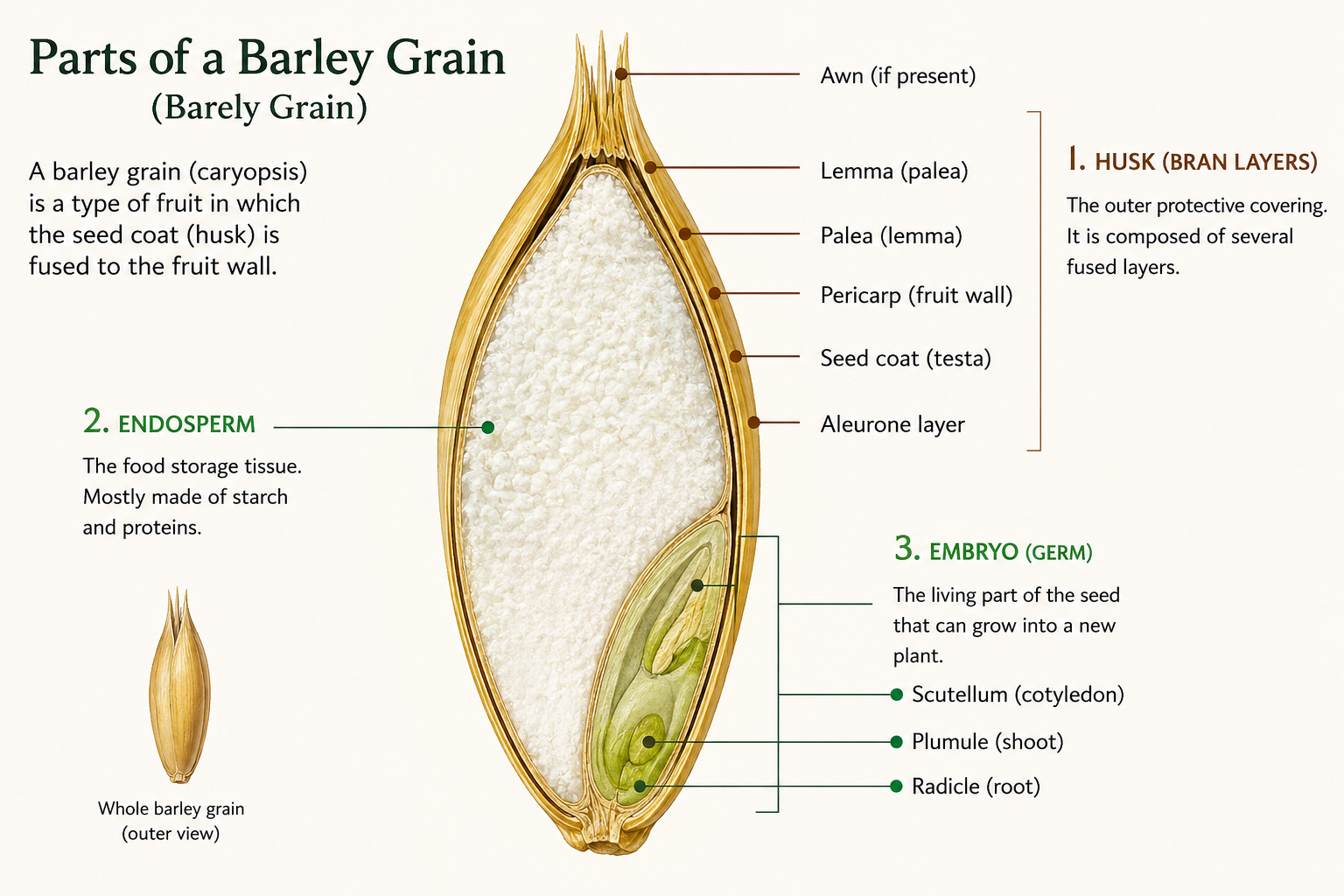
- The husk — the outer protective bran layers. In the mash tun it forms the filter bed that lets sweet wort run clear.
- The endosperm — the starchy food store that fills most of the grain. This is what the malting and mashing process unlocks, turning starch into the fermentable sugars that become beer.
- The germ — the living part of the grain, complete with shoot (plumule) and root (radicle). When the grain is malted, it is gently coaxed into beginning to germinate so that its own enzymes wake up — those enzymes are what later break the starches down.
The Three Cultivated Varieties
Three principal varieties are cultivated, named according to the number of rows of grain that they produce:
- Six-rowed barley — sown during the winter and used chiefly for feeding livestock.
- Four-rowed barley (sometimes called bere barley) — can be sown either in winter or spring. The grain is of comparatively poor quality, but it is extremely hardy and will grow in cold northern climates.
- Two-rowed barley — the kind most frequently cultivated in the United Kingdom. It is not so hardy as the others and is normally sown in the spring, but from the two-rowed barleys comes the finest grain for malting.
Farmers try to grow what is called a good malting sample
, which they can sell to brewers and distillers for a far better price than they can get for the coarse grain used to feed animals. Milled barley is of great value in fattening livestock, particularly pigs, and the grain is widely grown for this purpose alone.
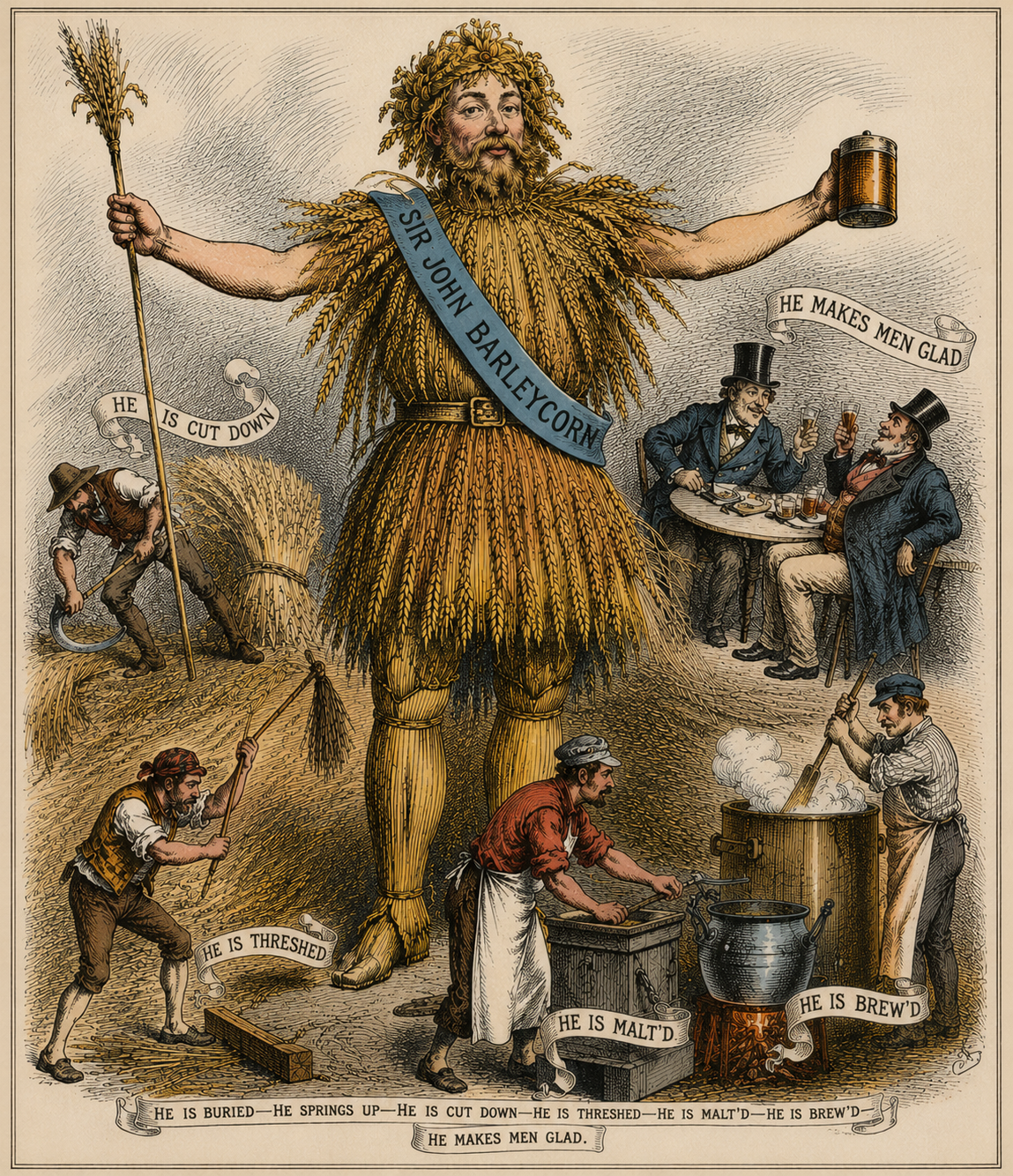
Beer, Whisky and Sir John Barleycorn
Barley has been cultivated in England for centuries in order to make alcoholic drinks. It is the basis of beer and whisky, and John Barleycorn (sometimes Sir John Barleycorn) is a very old personification, in English ballad, of the malt liquor made from barley. Robert Burns wrote:
Inspiring bold John Barleycorn!
— Robert Burns
What dangers thou canst make us scorn!
Beyond the Brewhouse
Barley also provides the malt used for medicinal purposes and in a number of foodstuffs. Although bread made from barley flour is eaten in many parts of Europe, and is probably as nourishing as wheaten bread, it is not used for this purpose by the British: it contains very little of the substance called gluten, which is necessary to produce a really good loaf.
The small round grains known as pearl barley are barley which has had the husk removed; they are used in soups and stews. Flour milled from barley is used for thickening soups and for making gruel for invalids — barley water is also made from it.
A Curious Measure
A “barleycorn” (a grain of barley) was at one time a measure of length. But since either three or four grains were reckoned to make an inch — and the grains vary in size — it can hardly have been a very accurate standard.