
Kegging, Casks & Gas
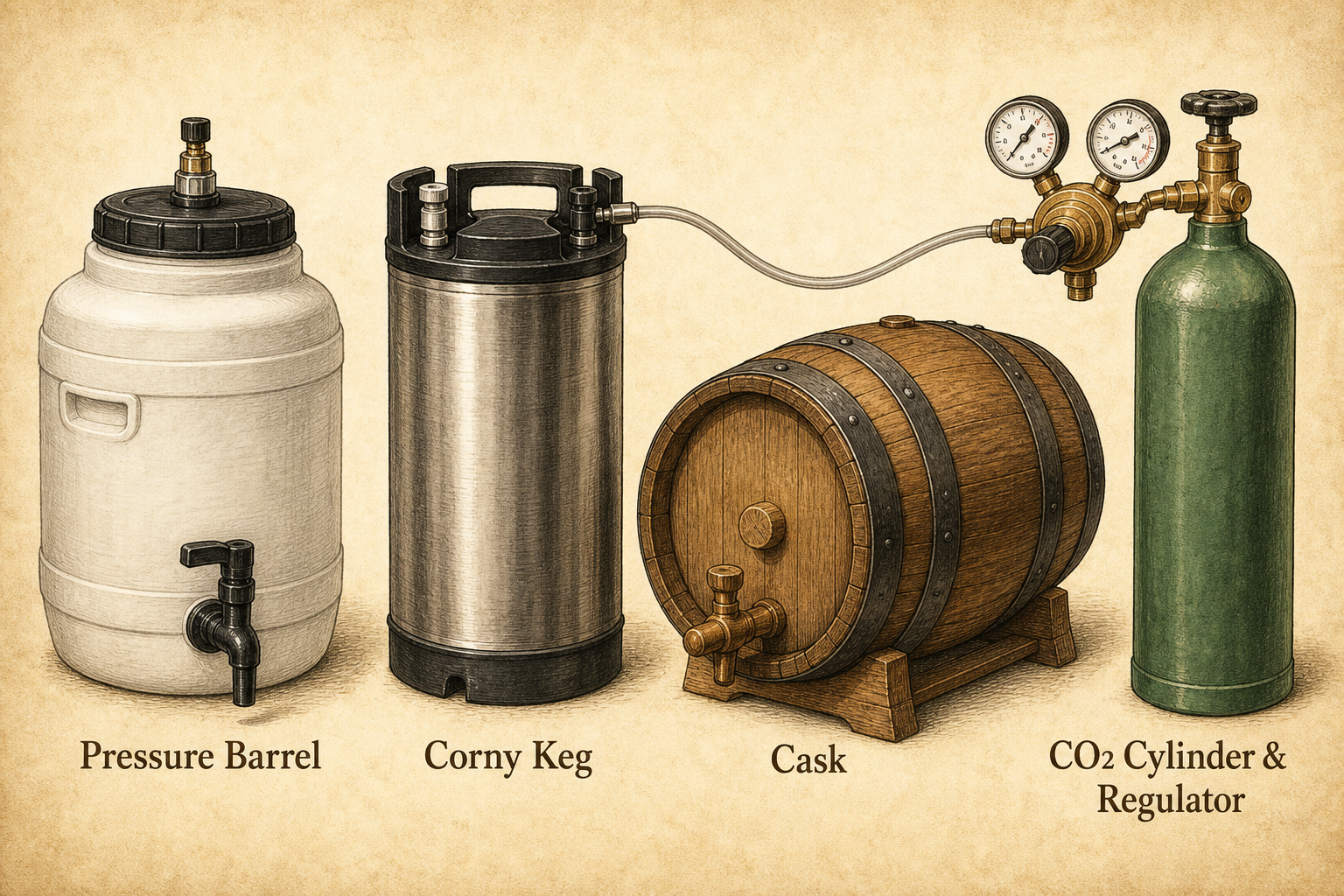
When the time comes to package your beer, the road forks. One path leads to the bottle — many small vessels, each conditioning on its own. The other leads to the bulk container: a single large vessel that holds the whole batch and serves it pint after pint. This is the world of the pressure barrel, the keg and the cask — and it is here that the brewer must decide whether the beer will be a living, naturally conditioned ale or a bright, gas-dispensed one.
It is also where one of the great divides in British brewing lives: the difference between cask-conditioned “real ale” and kegged, force-carbonated beer. Both have their place, and the homebrewer is free to choose either — but they are genuinely different things, and worth understanding before you commit a batch to one or the other.
The Pressure Barrel — the Homebrewer’s Classic
For generations of British home brewers the pressure barrel has been the natural home of a finished brew. It is a sturdy plastic keg, typically holding around 25 litres (enough for a five-gallon batch), with a tap near the base and a cap on top that takes a CO₂ injector or a self-sealing valve.
The beauty of it is simplicity. You rack the cleared beer into the barrel, add a small dose of priming sugar, and seal it. The yeast still in suspension ferments that sugar and throws off carbon dioxide, which — with nowhere to escape — dissolves into the beer and builds a gentle natural condition. This is secondary conditioning in the barrel, and it is exactly the same principle that conditions a bottle, only at a larger scale.
Corny Kegs & Keg Systems
The cornelius keg — the “corny” — came to homebrewing from the soft-drinks trade, and it has become the enthusiast’s favourite. It is a stainless steel cylinder, usually holding around 19 litres, sealed by a lid that seats more tightly the more it is pressurised. Two posts on top — one for gas in, one for beer out — connect by quick-release disconnects to a CO₂ line and a dispense tap.
A corny can be conditioned naturally with priming sugar, just like a pressure barrel, or it can be force-carbonated straight from the gas cylinder — the great convenience of the system. Stainless steel holds pressure confidently, cleans easily and lasts a lifetime, which is why so many brewers eventually graduate to it.
The Cask — Britain’s Living Beer
Then there is the cask: the vessel at the heart of the British real-ale tradition, and a genuine point of national pride. A cask — a firkin holds nine gallons, a pin half that — is filled with beer that is still very much alive. A little extra yeast and sugar, sometimes with dry hops dropped in, keep a slow secondary fermentation going right up to the moment it is served.
Real ale is a living product. It continues to mature and condition in the cask, and it is served without the addition of extraneous carbon dioxide.
— the Campaign for Real Ale (CAMRA)
This is the definition CAMRA has championed since 1971, when a handful of drinkers set out to rescue cask ale from the rising tide of fizzy keg beer. Cask-conditioned ale is dispensed by gravity straight from the cask or drawn up by a handpump — never pushed out by bottled gas. The result is softer, rounder and more aromatic, with a gentle natural condition rather than a brisk fizz.
The Great Distinction — Cask vs Keg
This is the divide worth understanding before you choose. The same beer can become two quite different drinks depending on how it is conditioned and served.
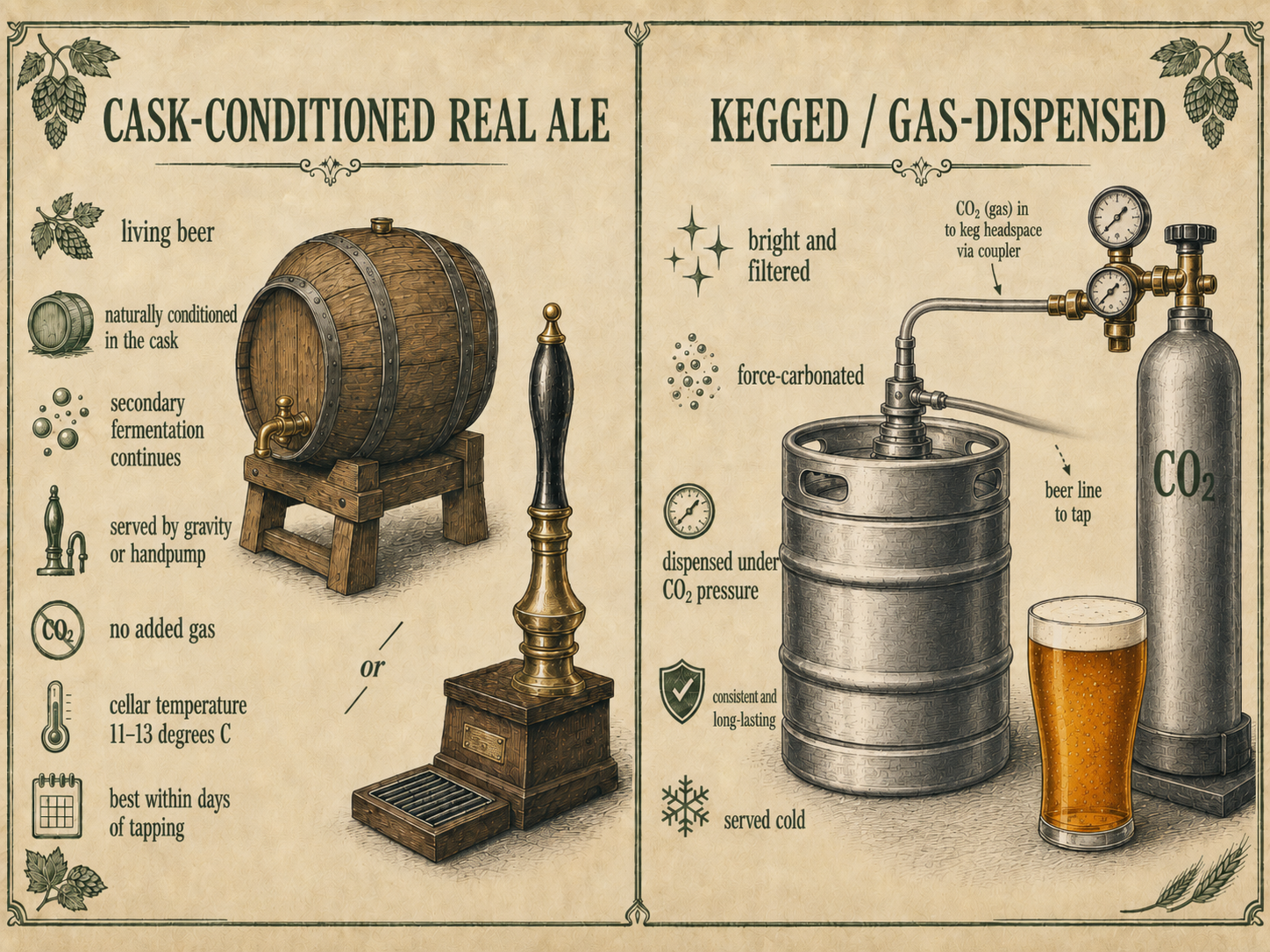
- CASK Conditioning
- A living beer; secondary fermentation continues in the vessel, building a soft natural condition. No gas is added.
- CASK Serving
- Drawn by gravity or handpump at cellar temperature (11–13°C). Best within a few days of tapping, while it is at its peak.
- KEG Conditioning
- Usually bright and filtered, then force-carbonated from a CO₂ cylinder to a precise, consistent fizz.
- KEG Serving
- Dispensed cold under gas pressure. Stable for weeks, since the CO₂ blanket keeps the beer fresh and the carbonation steady.
Natural vs Forced Carbonation
Whichever vessel you choose, the bubbles get there in one of two ways. Natural carbonation relies on the yeast: a measured dose of priming sugar in the sealed container is fermented out, and the carbon dioxide produced dissolves into the beer. It is slow — a week or two in the warm, then a spell in the cool — but it gives a fine, mellow condition and needs no special kit.
Forced carbonation dispenses with the yeast entirely. Connect a sealed keg to a CO₂ cylinder, set the regulator to the working pressure, and let gas dissolve into the cold beer over a day or two. It is quick, repeatable and exact — you choose the level of fizz and the gas delivers it. The trade-off is the equipment and the slightly cleaner, less “living” character of the result.
Gas — Carbonating and Dispensing
For kegged beer, carbon dioxide does two jobs at once: it carbonates the beer and it pushes it out of the tap. The setup is a CO₂ cylinder, a regulator with two gauges — one reading the pressure in the bottle, the other the working pressure you have set — and a line to the keg.
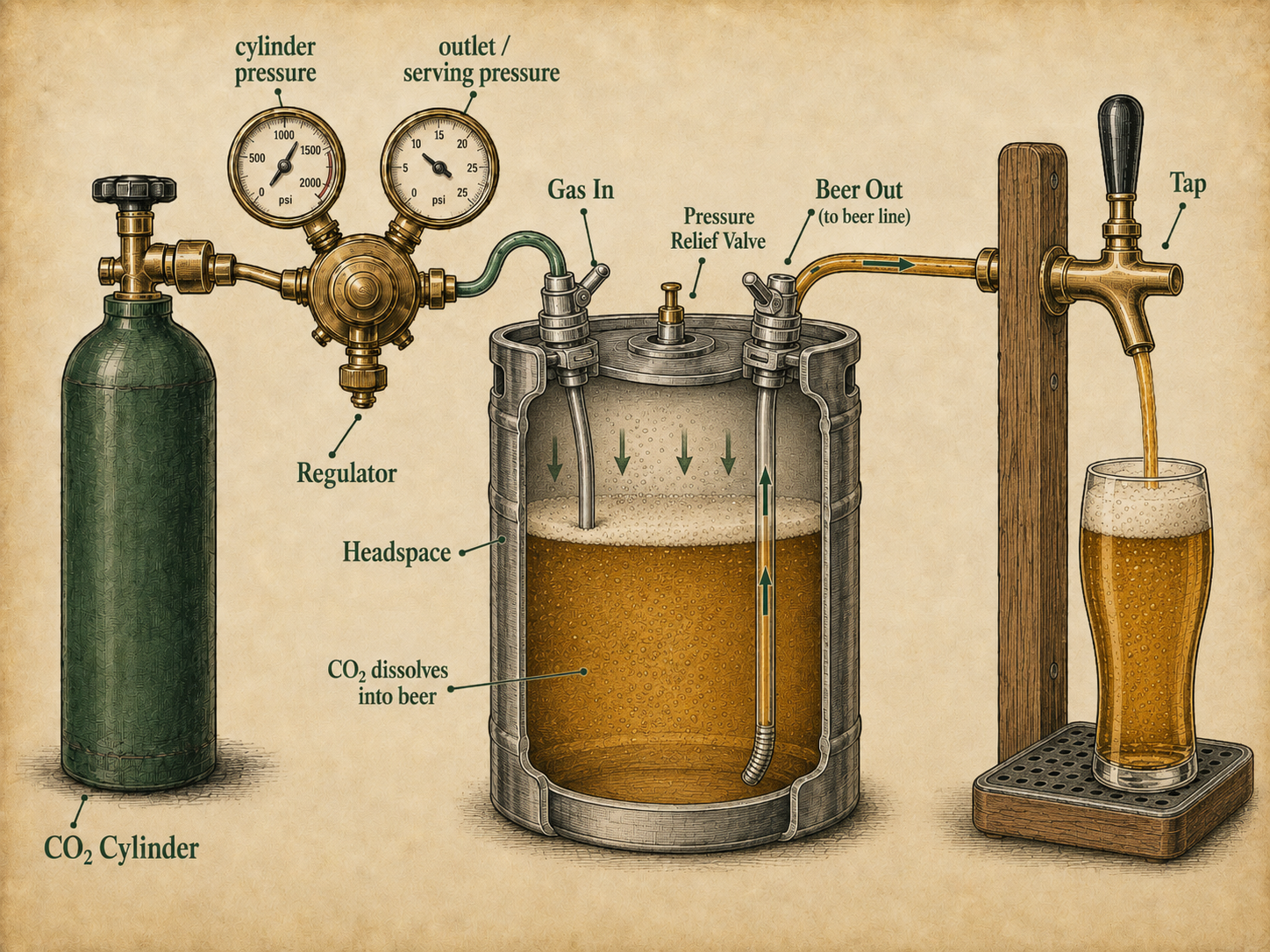
Most ales sit happily at a modest pressure; pale, brisk lagers want more. Some brewers use a mixed gas — a CO₂ and nitrogen blend — for stouts and creamy keg ales, where the tiny nitrogen bubbles give that famous tight, cascading head without over-carbonating the beer.
Cellaring, Conditioning & Serving
Temperature rules everything in the cellar. A freshly filled barrel or cask wants a fortnight somewhere warmish (around 18–20°C) to finish its conditioning, then a move to a cool, steady spot to settle bright and drop clear. Serve British ales at cellar temperature — 11–13°C, not fridge-cold — so the flavour and aroma come through.
- Let it settle — once moved to the cool, leave a barrel or cask undisturbed for a day or two so any sediment drops to the bottom.
- Vent gently — a naturally conditioned cask is tapped and soft-spiled to let it “come into condition” before serving.
- Mind the air — as a pressure barrel empties, a little injected CO₂ keeps air off the beer and stops it going flat or stale.
- Drink it in its prime — cask ale is at its best within days; kegged beer under gas will keep for weeks.
From barrel to cask to keg — the last journey before the glass.