
Sparging
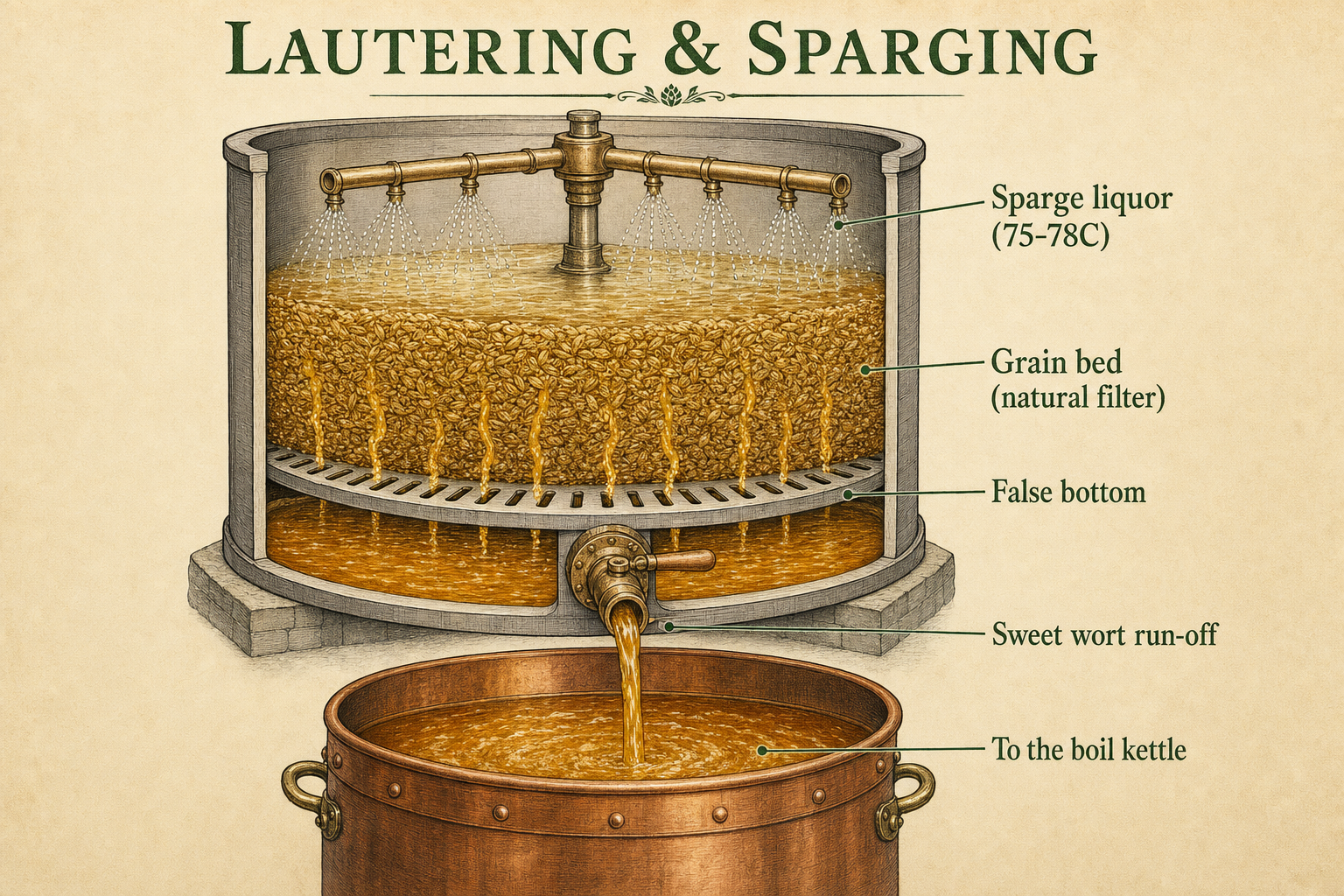
Sparging is the unglamorous but decisive step that follows the mash: separating the sweet wort from the spent grain and rinsing every last fermentable sugar from the bed. Done patiently it rewards you with a clear run-off and good efficiency; done in a hurry it can drag harshness into the kettle. The collected wort then heads to the boil.
Lautering — the Run-Off
Once the rests are finished, the liquid must be drawn away from the goods. This separation is called lautering, from the German läutern, “to clarify”. The great trick of it is that you need no special filter cloth: the grain husks themselves, settled into a loose bed above a slotted false bottom or a perforated plate, form a natural filter. As the wort is drawn off slowly from below, it percolates down through that bed and leaves the fine particles behind, running clearer with every inch it travels.
The watchword is gentle. Open the tap too far and the bed compacts into a tight, gummy mat — a stuck mash
that will scarcely run at all. A steady, unhurried draw lets the husks do their work without packing down.
Recirculation — Running It Bright
The very first wort to come off is cloudy, carrying flour and grain debris before the filter bed has properly set. Rather than send that murk to the kettle, the brewer draws off a jug or two and pours it gently back over the top of the grain. This is the vorlauf (another German term, meaning the “fore-run”), or simply recirculation.
Run it back until it runs bright — then, and only then, let it flow to the kettle.
A handful of recirculated litres is usually enough; you will see the run-off turn from milky to a clean, glinting amber. From that point the wort is collected in earnest.
Sparging Proper
Draining the tun alone leaves a great deal of sugar clinging to the grain. To recover it, hot liquor is sprinkled over the bed to rinse the sugars through — this rinsing is sparging, from an old dialect word meaning to sprinkle or splash. The two traditional methods differ chiefly in how the water is applied.
- Fly Continuous Sparge
- Hot liquor is sprinkled steadily over the top while wort is drawn from below at a matching rate, so a shallow layer of water always rides above the grain. Slow and efficient — favoured in traditional British brewhouses — but it demands a careful, balanced hand.
- Batch Batch Sparge
- The tun is drained fully, then refilled with a measured charge of hot liquor, stirred, allowed to settle and drained again — often in two runnings. Quicker and more forgiving, and a fine choice for the homebrewer.
Why 75–78°C?
Sparge liquor is held at about 75–78°C for good reason. At that warmth the sugars are mobile and rinse freely from the bed, and the wort thins enough to flow cleanly. Go much hotter, though, and you begin to leach harsh tannins from the husks — the same astringent grip you find in over-stewed tea. Kept in this window, the liquor washes the goods without scalding flavour from them.
The Danger of Over-Sparging
It is tempting to keep rinsing for every last gram of sugar, but there is a point of diminishing — and then negative — returns. As the bed gives up its sugar, the run-off grows weaker and its pH drifts upward; in that thinner, less acidic liquor the husks surrender tannins all the more readily. The result is a wort tainted with grainy, mouth-puckering astringency that no amount of later care will mend.
- Watch the run-off gravity with a hydrometer or refractometer and stop sparging when it falls to around 1.008–1.010.
- Stop, too, once you have collected your target volume for the boil — chasing a little extra sugar is rarely worth the tannin it buys.
- Keep the liquor in the 75–78°C window and the pH in check, and the bed will reward you with bright, clean wort.
Rinse it gently, run it bright, and let no harshness follow the sugar to the kettle.