
Water Treatment
Water is the brewer’s largest ingredient by far — a pint of beer is more than nine-tenths water, and the old brewers knew it well enough to give it a name of its own: liquor. Yet it is no blank canvas. The minerals dissolved in it shape the bitterness, the body and the very colour of the finished beer, and for centuries the character of a town’s water decided what kind of beer that town brewed best.
Hardness & the Key Ions
What we loosely call hardness is really a question of which minerals the water has gathered as it passed through the ground. A handful of ions do nearly all the work, and the brewer learns to read them like a recipe:
- Ca²⁺ Calcium
- The brewer’s friend — it lowers mash pH, helps the enzymes work, aids clarity and assists yeast in settling out.
- SO₄²⁻ Sulphate
- Accentuates a crisp, dry, lingering bitterness — the signature of a good pale ale.
- Cl⁻ Chloride
- Rounds out the palate, lending a fuller, sweeter, maltier body.
- HCO₃⁻ Carbonate / Bicarbonate
- Raises pH and resists the mash’s natural acidity. Welcome in dark, roasty beers; troublesome in pale ones.
The Sulphate-to-Chloride Balance
If there is one dial the brewer turns more than any other, it is the balance between sulphate and chloride. The two ions pull a beer in opposite directions, and their ratio — far more than their absolute amounts — sets the tone of the finished pint.
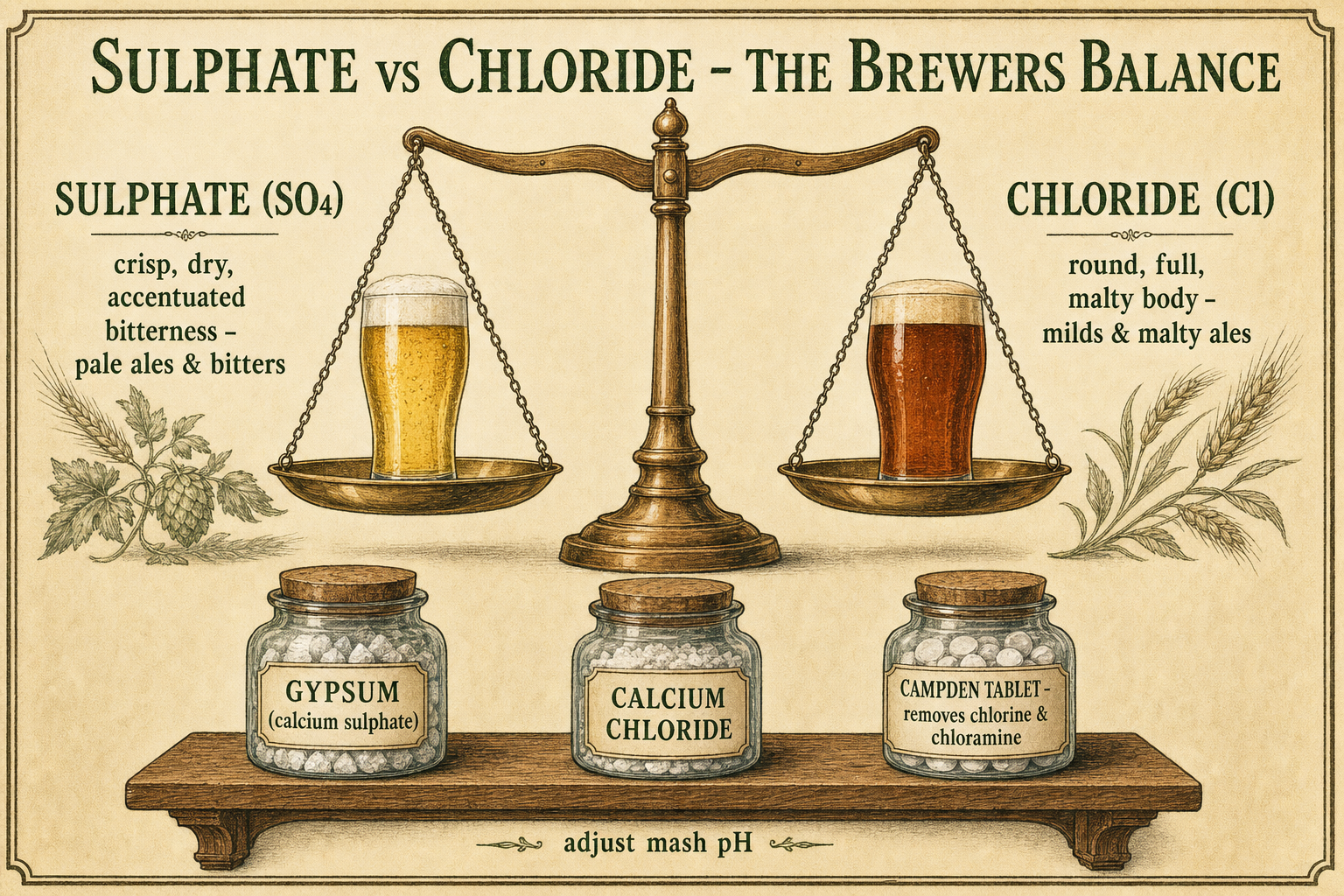
Lean towards sulphate and the bitterness stands tall and dry — just the thing for a hoppy pale ale or a sharp bitter. Lean towards chloride and the beer turns soft and rounded, the malt brought forward — the making of a mild or a malty old ale. Most brewers think in terms of the ratio: roughly two parts sulphate to one of chloride for a crisp pale ale, the reverse for a malt-led beer, and an even hand for something balanced.
A Heritage Written in Water
Long before anyone could measure an ion, brewers had discovered the same truths by taste, and the great brewing towns each owed their fame to what lay beneath them.
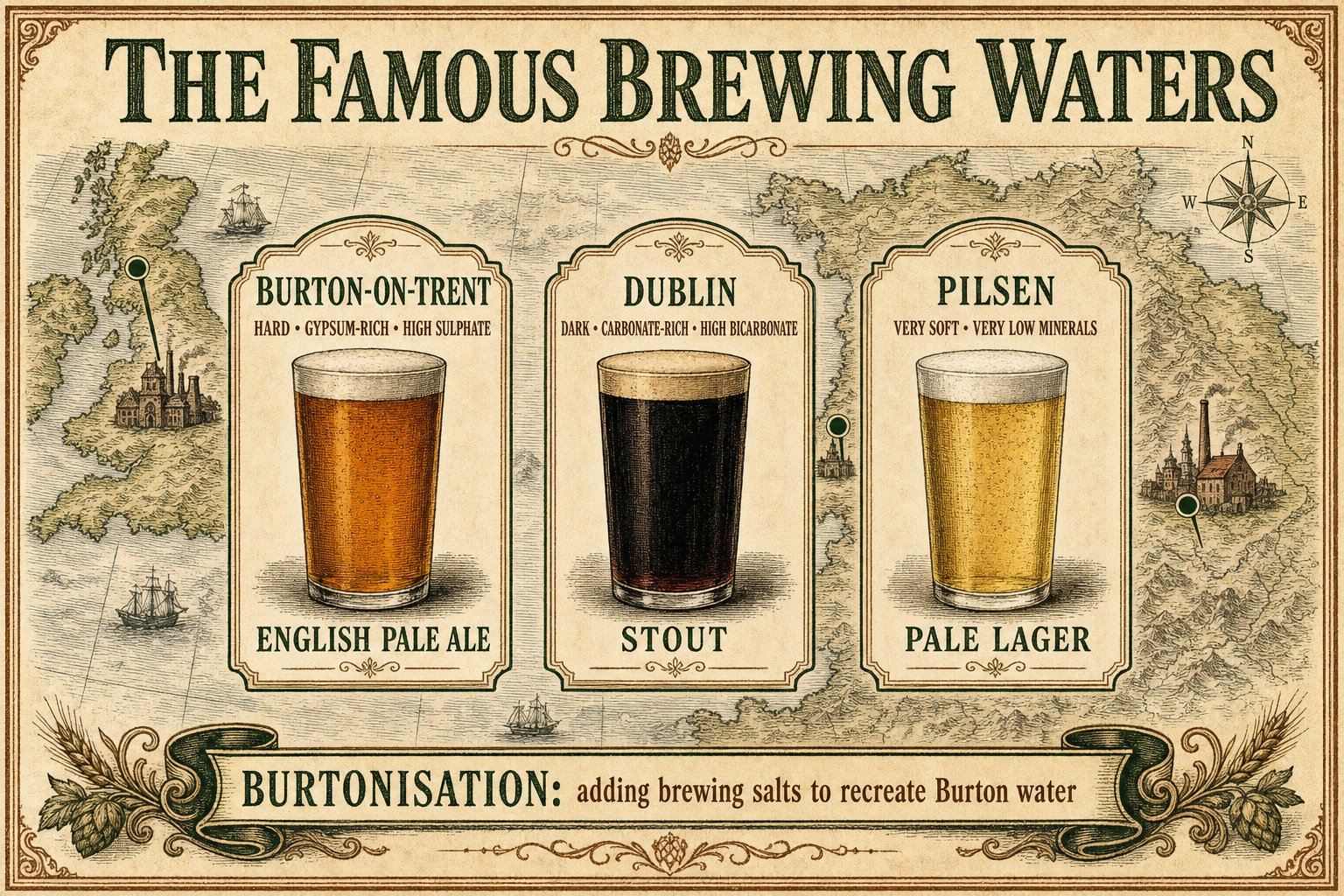
- Burton-on-Trent — hard water rich in gypsum (calcium sulphate) drawn from the gypsum beds beneath the town. That bright, dry, sulphate-driven bitterness made Burton the home of the English pale ale, and brewers the world over still chase its character.
- Dublin — dark, carbonate-rich water that turns a pale beer harsh, but suits the roasted grains of a stout perfectly, the high bicarbonate buffering their acidity. Geography wrote Ireland’s love of the black pint.
- Pilsen — water so soft it is almost free of minerals, the clean slate behind the delicate golden pale lager first brewed there in 1842.
So renowned was the Burton water that brewers elsewhere began adding salts to their own liquor to imitate it — a practice still known by its proper Victorian name, Burtonisation. It was, in effect, the first deliberate water treatment, and the foundation of everything below.
You can carry coals to Newcastle, but you cannot carry Burton water to Newcastle — so the brewers learned to make their own.
Treating Your Liquor
The home brewer need not move to Burton. With a little knowledge and a few inexpensive salts, almost any tap water can be coaxed towards the profile a recipe wants. Three jobs cover most needs:
- Remove the chlorine. Mains water is treated with chlorine or chloramine, which lend beer an unpleasant medicinal, plasticky taint. A single crushed Campden tablet per 20–25 litres neutralises both in moments — the simplest and most worthwhile treatment of all.
- Add the right salts. Gypsum (calcium sulphate) adds calcium and sulphate to sharpen a pale ale; calcium chloride adds calcium and chloride to round out a malty beer. A few grams, dissolved into the liquor before mashing, is usually all it takes.
- Adjust the mash pH. The salts above, especially the calcium, gently pull the mash into its ideal range of about 5.2–5.6. Hitting that window gives the enzymes their best working conditions and rewards you with clearer wort and cleaner flavour.
From here the treated liquor flows straight into the mash, where it steeps the crushed grain, and on through the sparge that rinses the last of the sugars away. Get the water right and everything that follows has a head start.
Right liquor, right beer — it all begins with the water.