
Hops
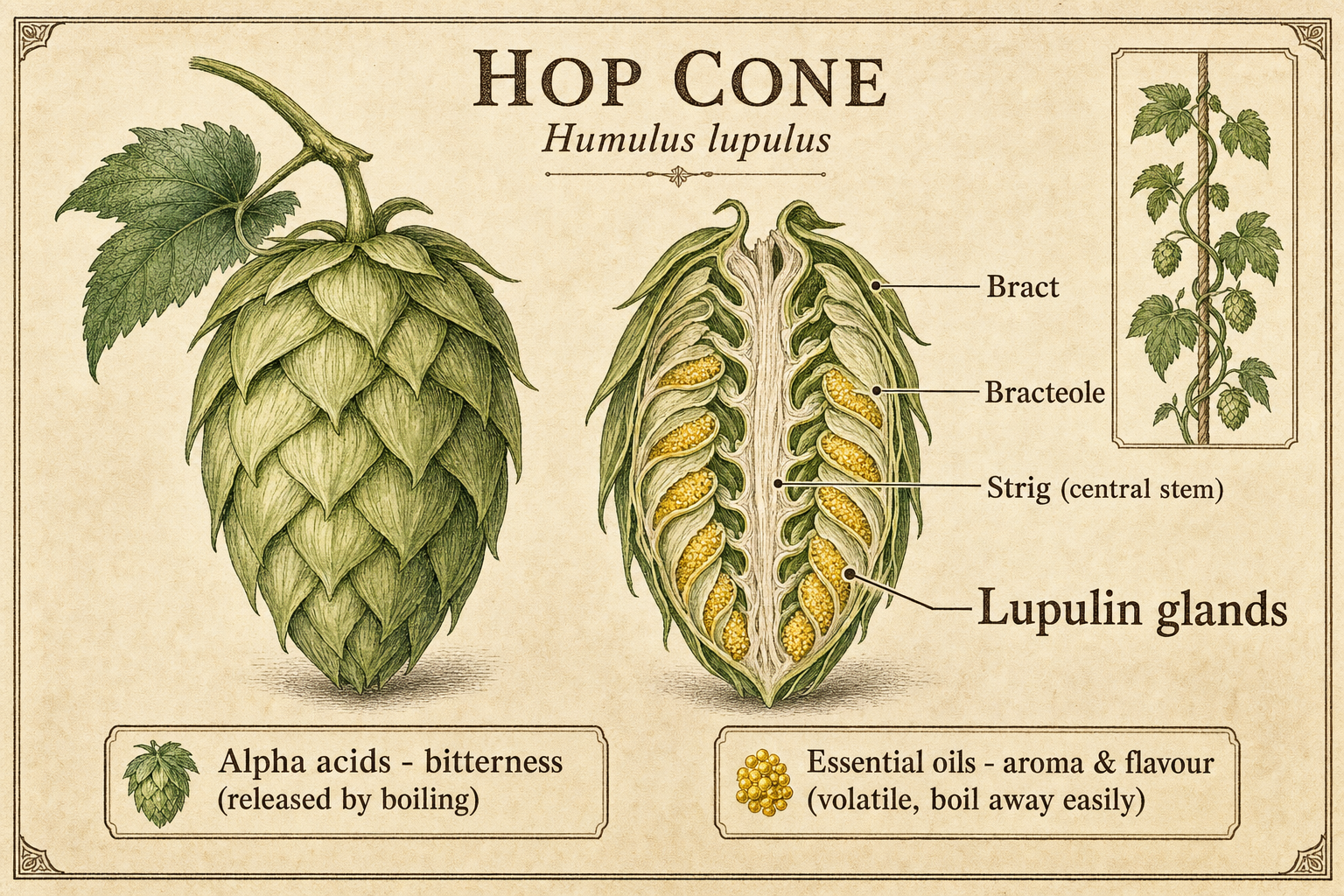
The hop is the flower that makes beer taste like beer. Without it, the sweet wort drawn from the mash would ferment into something cloying and short-lived; with it, the brewer gains bitterness to balance the malt, a vast palette of flavour and aroma, and a natural preservative that helps the finished beer keep. For all that work, the hop asks only to be added to the boil — and, sometimes, dropped quietly into the cask.
The Plant
Botanically the hop is Humulus lupulus, a vigorous climbing perennial of the same family as cannabis. It does not twine as a vine but climbs as a bine — a stem that hauls itself upward on stiff hairs rather than tendrils, and which in a good season will scramble six metres or more up its strings. Brewers grow only the female plants, for it is the female that produces the papery green flowers, or cones, that the brewhouse wants.
Hops have been grown for ale in England since at least the fifteenth century, when the practice arrived from the Low Countries and slowly converted a nation of unhopped ale-drinkers to hopped beer. The great hop gardens of Kent, Herefordshire and Worcestershire became part of the rural calendar, and each autumn whole families travelled out from the cities to pick.
Inside the Cone
Split a ripe cone open and you find, clustered at the base of each papery bract, a dusting of sticky golden-yellow grains. This is lupulin, and it is the whole point of the hop. Everything the brewer values is concentrated in these tiny glands. Rub a fresh cone between your palms and the resinous, almost narcotic smell that lingers is lupulin at work.
The lupulin offers two distinct gifts, and understanding the difference between them is the key to using hops well:
- Alpha acids — bitter resins that are barely soluble as they stand. Boil them, however, and they isomerise into a form that dissolves readily and tastes intensely bitter. This is why bittering hops must be boiled, and boiled hard: it is the heat that unlocks the bitterness. A variety’s alpha-acid percentage tells the brewer how much bittering power it carries.
- Essential oils — the volatile aromatic compounds that give each variety its character, from earth and pepper to grapefruit and pine. These are fragile. The very heat that releases bitterness drives the oils off in the steam, so the longer a hop boils, the less of its aroma survives.
From this single tension — bitterness needs the boil, aroma is destroyed by it — flows almost everything about how hops are used.
Cones or Pellets?
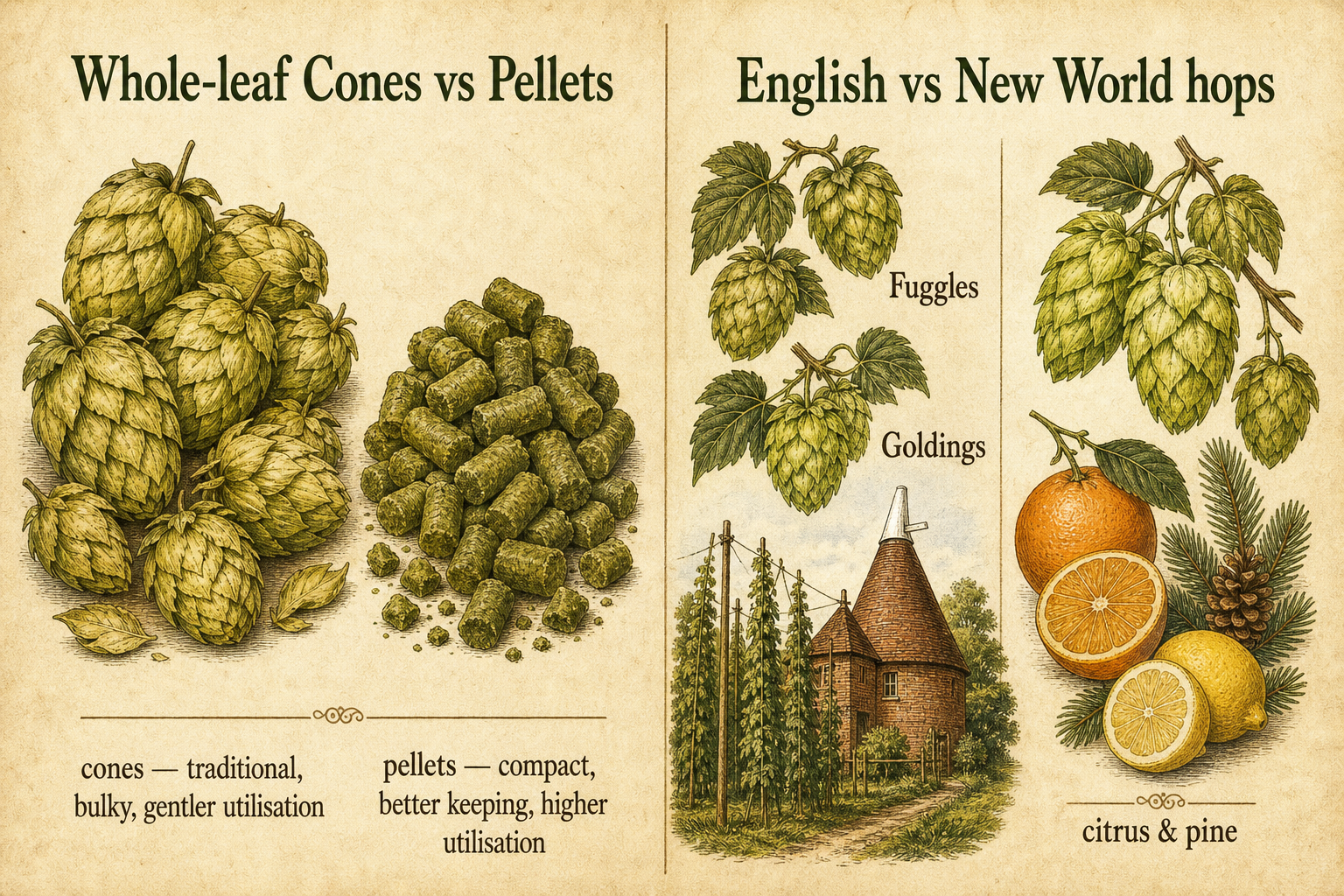
Hops reach the brewer in two main forms. Whole-leaf cones are the traditional choice — simply the dried flowers, loose and papery. They are bulky, demand careful storage away from light, air and warmth, and give up their goodness a little more gently. Pellets are cones that have been milled and compressed into dense green cylinders. They take far less room, keep better once sealed, and tend to give higher utilisation — that is, the brewer extracts more bitterness and aroma per gramme — because the grinding ruptures the lupulin glands and exposes their contents. Many homebrewers keep both: pellets for everyday bittering, whole cones when they want the romance of the old way.
Whichever form you choose, store it cold and airtight. Hops are perishable; alpha acids fade and the delicate oils oxidise, so a vacuum pack in the freezer is the hop’s best friend.
The Varieties
There are scores of hop varieties, but for the British brewer they fall broadly into two camps.
The classic English hops are prized for a restrained, dignified character — earthy, peppery, faintly floral, never shouting. The two great names are Fuggles and Goldings, the backbone of countless bitters and milds. Grown in the hop gardens of Kent and the western counties, they were traditionally dried in oast houses — those distinctive round or square kilns with the white-cowled cap that turns with the wind, a sight as much a part of the English countryside as the church and the inn. To brew a pint with Goldings is to taste several centuries of tradition.
The New World aroma hops — from America, Australia and New Zealand — are a louder proposition altogether: bursting with citrus, tropical fruit, resin and pine. Bred for big, expressive aroma, they are what give modern pale ales their unmistakable grapefruit-and-pine lift. They reward a late, gentle hand far more than a long, hard boil.
Putting Hops to Work
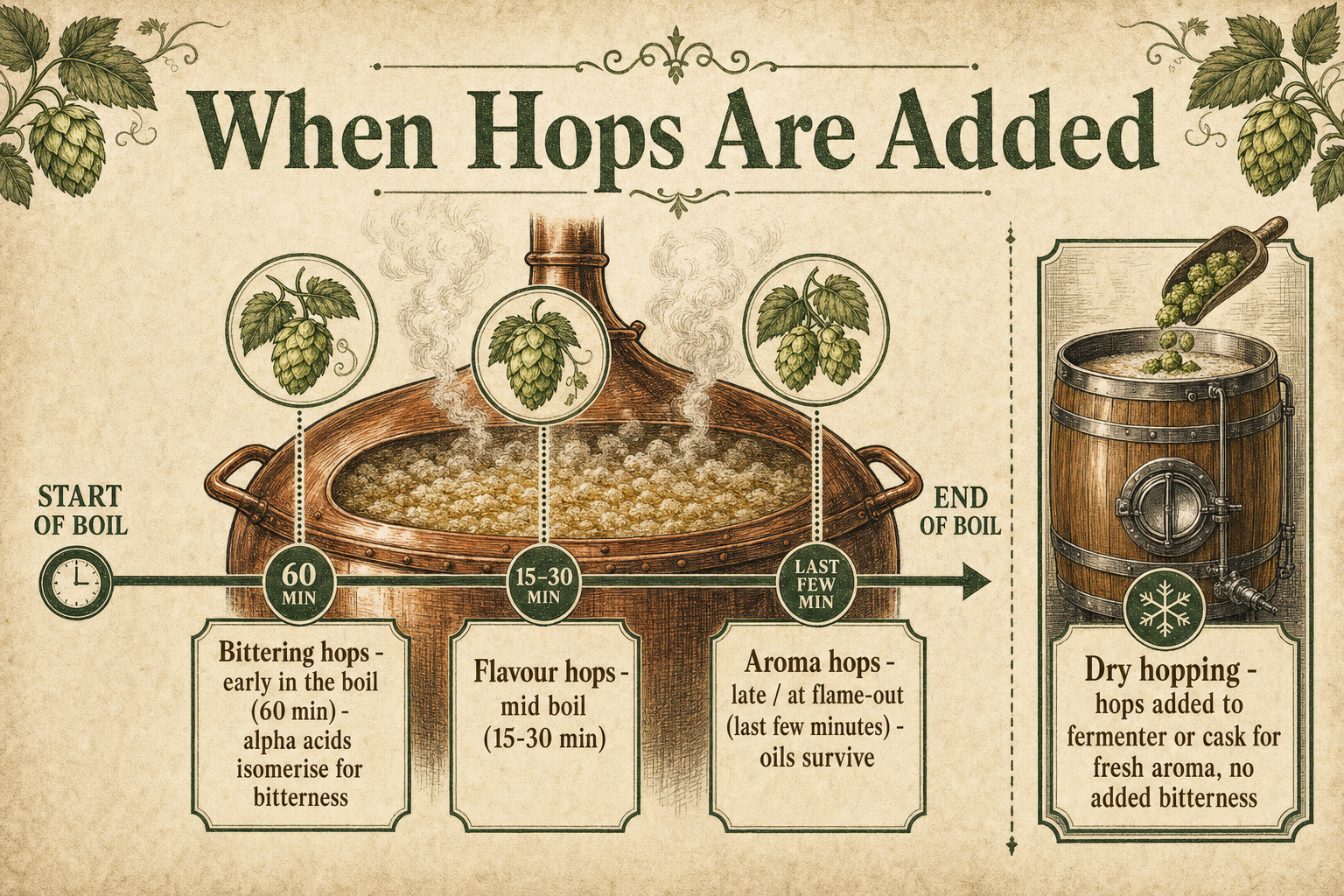
Because bitterness needs heat and aroma cannot stand it, brewers add hops in stages across the boil. Think of the kettle as a clock:
- 60 min Bittering Hops
- Added at the start and boiled hard so the alpha acids isomerise fully. This is where a beer’s backbone of bitterness is built; the aroma from these hops is long gone by the end.
- 15–30 min Flavour Hops
- Added in the middle of the boil — long enough to give some bitterness, short enough to keep a measure of hop flavour.
- 0–5 min Aroma Hops
- Thrown in at the very end, or at flame-out, so the precious essential oils survive into the finished beer. This is where the lift of fresh hop aroma comes from.
There is one more trick, used after the boil is long over. Dry hopping means adding a charge of hops cold — to the fermenter, or to the cask as the beer conditions — and letting them steep for days. With no heat involved, no bitterness is extracted at all; instead the beer drinks up a fresh, vivid aroma straight from the lupulin. It is the secret behind the heady nose of a well-made pale ale, and a finishing flourish a cask brewer can add right up until the beer goes out. (See racking and conditioning for how this fits into the cask’s final days, and fermentation for the stage where it most often happens.)
Malt is the body of beer — the hop is its soul.