
Use A Hydrometer
How to take a reliable hydrometer reading, and how to use two of them to calculate the ABV, or alcohol by volume, which is what you'll find (in Britain) on the side of commercial bottles of beer, wine, spirits, and so on.
Getting a sample
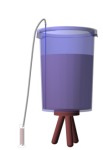
First, we need to get a sample of your brew to test. There are several ways to do this. The most common is to syphon some of the liquor into a testing jar (it looks like a large test tube).
An easier method is to use a wine thief, if you have one. Simply lower the thief into the liquor until the button on the bottom touches the base of the container. This lets the liquor flow inside through the hole in the bottom. Then remove the thief from the container. You can now place the hydrometer directly into the top of the thief.
Placing the hydrometer
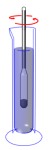
Now we need to place the hydrometer into the sample jar. If you have a glass jar, remember to lower the hydrometer in slowly — many a hydrometer has been broken just by hitting the bottom of the jar.
Once the hydrometer is in the jar, hold the top between your thumb and finger and spin it. This should remove any bubbles clinging to the side of the hydrometer, which would otherwise throw off your reading.
Taking a reading
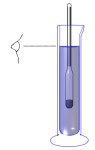
To get a good reading, you need to read the hydrometer at eye level. (Placing the testing jar on a high surface can help with this.)
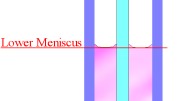
How you read the hydrometer depends on your particular model. Most good hydrometers and lab instruments read from the lower meniscus — that is, from the actual liquid surface rather than from the top of the liquid that climbs up the side of the jar and hydrometer. Some hydrometers read from the upper meniscus; check your instrument's instructions to find out which type you have.
Recording the reading
Now you've got your reading, write it down. It is best to record the whole number to three decimal places, for example 1.050. The last decimal place is hard to read on a normal hydrometer, so just do the best you can.
However, this is not your final reading. For accurate measurements you need to adjust for temperature. Most home hydrometers are calibrated for 20°C. Use a thermometer to get the exact temperature of the liquid and then use the temperature correction table that comes with the hydrometer to work out the real reading. (The correction will be roughly −0.001 for every 4°C below 20°C, and +0.001 for every 4°C above.) Your result can now be called the Specific Gravity (SG).
Calculating alcohol content
To calculate the alcohol level in a liquid with a hydrometer, you need two readings:
- Original Gravity (OG) — the specific gravity of the liquid before any yeast is added. (There is no way to calculate this after the liquor has fermented.)
- Final Gravity (FG) — the specific gravity of the liquid after all fermentation is complete.
Once you have both readings corrected for temperature, head over to our Alcohol Calculator. Enter your OG and FG and it does the maths.